.jpg?width=612&height=151&name=Intellinet%20Systems%20Logo%20(1).jpg)
.png?width=1100&height=500&name=Why%20Pre-Delivery%20Inspections%20Fail%2010%20OEM%20PDI%20Root%20Causes%20(1).png)
Aftermarket
Intelli PDI


Choosing an electronic parts catalog platform is one of those decisions that looks straightforward on paper and gets complicated fast in practice. Two platforms can both carry the "EPC software" label, pass your initial shortlist criteria, and still be built around fundamentally different assumptions about who uses them and how.
That gap matters most for OEM aftermarket teams managing dealer networks. The electronic parts catalog market broadly splits into two categories: platforms designed around technical publishing and PLM workflows, and platforms designed around dealer network operations and aftermarket revenue. Both solve real problems. But they solve different problems for different users.
Intelli Catalog and PTC's catalog solution represent these two orientations. PTC's Arbortext-based approach is rooted in structured content authoring and enterprise documentation, a strong fit for organizations where technical publishing is the primary requirement. Intelli Catalog is built specifically for OEM aftermarket operations, with dealer usability and parts ordering accuracy at the center of its design.
This comparison lays out where the two platforms differ across features, implementation, dealer fit, and pricing, so OEM aftermarket heads, parts directors, and IT leads can make that call with a clearer picture of what they're actually choosing between.
PTC is a Product Lifecycle Management (PLM) company. Its catalog capabilities come through Arbortext, a technical documentation and XML publishing platform, and through its broader Service Lifecycle Management suite that includes Windchill, Creo Illustrate, and Service Center. The EPC functionality is one component inside a large enterprise product architecture.
The platform is designed primarily for organizations that need to manage complex technical documentation at scale, think aerospace manufacturers, defense contractors, and heavy industrial equipment companies where rigorous documentation standards, multi-language publishing workflows, and regulatory compliance requirements drive the technology decisions. The dealer parts ordering experience is downstream of that publishing capability.
Intelli Catalog comes from a different starting point. It was built specifically for OEM aftermarket operations the workflows that happen after a product leaves the factory and enters a dealer network. Parts identification, order accuracy, supersession management, dealer channel analytics, and integration with service and warranty operations are the core design priorities, not a side-effect of a larger publishing platform.
That difference in origin shapes almost every feature comparison that follows.
|
Capability |
Intelli Catalog |
PTC (Arbortext / SLM) |
|
Primary use case |
OEM aftermarket dealer operations |
Technical documentation & PLM publishing |
|
Parts search |
AI search, visual search, VIN/serial number, natural language |
XML-based search, VIN filtering, and advanced configuration search |
|
2D / 3D illustrations |
Hotspot-enabled, interactive, dealer-facing |
Interactive 2D/3D with Creo Illustrate (separate product) |
|
Supersession management |
Real-time, automated dealer alerts |
Change management through authoring workflow |
|
Dealer ordering workflow |
Built-in, with cart and DMS integration |
Via ERP/e-commerce integration (requires configuration) |
|
Go-live time |
As fast as 7 days |
Typically 3–8 months (varies by customization) |
|
Implementation complexity |
Low designed for non-XML teams |
High requires XML/DITA expertise or implementation partner |
|
Customization risk |
Low configurable without code changes |
Medium-High customizations can break on version upgrades |
|
Dealer analytics |
Built-in: order trends, search behavior, dealer performance |
Limited requires third-party BI tooling |
|
ERP / DMS integration |
Native connectors, quick setup |
Available via standard APIs, partner-configured |
|
Offline access |
Available |
Available |
|
Microsoft Marketplace |
Listed and Azure-hosted |
Not listed |
|
Pricing model |
Modular, OEM-scale pricing |
Enterprise licensing, per-user subscription from ~$250/user/month |
|
Best fit |
OEMs running dealer networks of any size |
Large enterprises with existing PTC/PLM infrastructure |
The most important functional difference for a dealer network is how technicians find parts.
Intelli Catalog is built around multiple search entry points: serial number or VIN-based parts lookup that filters the catalog to the exact machine configuration, AI-powered natural language search, visual search where a technician can identify a component from an image, and traditional part number or description search. Any of these paths leads to the same outcome: the correct part, for the correct configuration, in a few clicks.
PTC’s search capability is XML-based and configuration-driven. It is technically accurate and supports VIN-based filtering, but it was designed for service technicians working from structured documentation, not for dealer parts staff who may be working across dozens of machine models with varying levels of product knowledge. The advanced search requires familiarity with the catalog structure, and the interface reflects its technical publishing origins.
In practice, the search experience gap shows up most clearly in dealer onboarding. A new dealer technician using Intelli Catalog can be productive within a day, because the interface mirrors how a technician thinks about a problem: “I’m looking at the hydraulic pump assembly on this serial number.” A PTC-based catalog requires more training investment to reach the same level of proficiency.
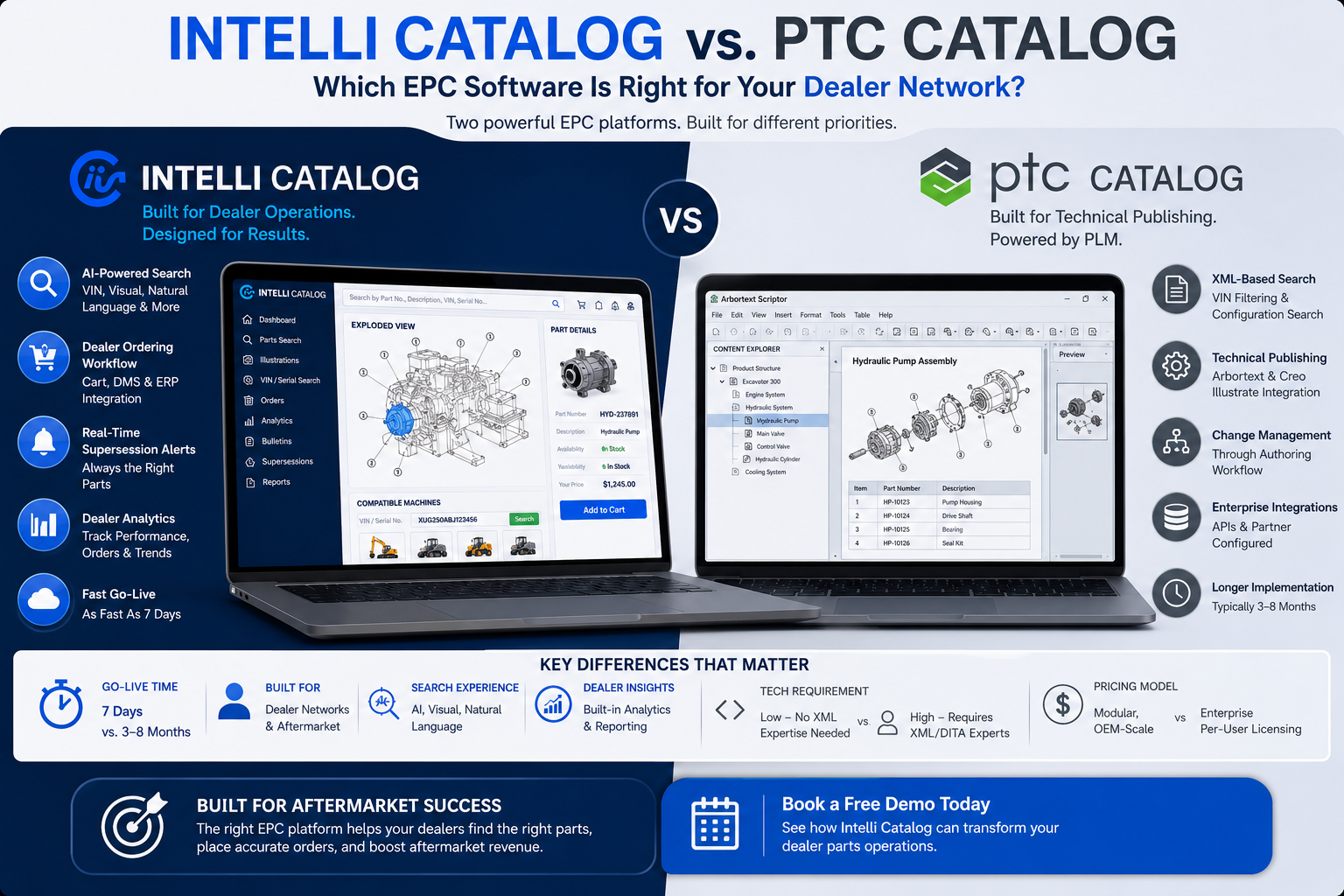
PTC’s Arbortext implementation has a well-documented complexity profile. Most organizations engaging with PTC for an EPC deployment need an implementation partner. The initial content migration, XML/DITA authoring setup, stylesheet customization, and integration work typically runs three to eight months, with larger implementations extending beyond that. Customization, which most OEMs eventually require to match their catalog structure and branding, adds additional cost and creates a version lock-in risk: when PTC releases a new version of Arbortext, customizations sometimes need to be rebuilt for compatibility.
This is not unique to PTC. Any enterprise PLM platform carries implementation weight. But it becomes a significant issue when the OEM’s actual need is dealer network support and parts revenue, not a regulated documentation publishing workflow. The implementation investment is calibrated for the latter, not the former.
Intelli Catalog’s implementation model is built around OEM aftermarket timelines. The standard go-live path runs as fast as seven days for a basic deployment, with integrations to ERP and DMS systems layered on top of that foundation. The catalog authoring environment does not require XML expertise content teams who manage product data rather than technical documentation can handle catalog updates directly, without partner involvement.
For an OEM running a 300-dealer network, the difference between a three-month implementation and a seven-day go-live is not a minor administrative detail. It is three months of missed order accuracy improvements, three months of dealers working from outdated catalogs, and three months of parts revenue going to third-party platforms that have already given dealers a better search experience.
PTC’s platform is designed for the team that manages technical documentation at the OEM level. The primary users are technical writers, documentation managers, and service information authors. Dealers are the end consumers of the output of the published catalog, but the workflow, the interface, and the feature set are built around the content creation and publishing side.
Intelli Catalog is designed from the dealer perspective outward. The platform includes features that have no equivalent in a technical publishing platform: dealer-specific order workflows, promotional bulletin delivery to dealer networks, purchase history-based part suggestions, dealer performance analytics that let OEM aftermarket heads see which dealers are using the catalog effectively and which are defaulting to manual processes or third-party suppliers.
That operational visibility matters more than most OEM teams realize until they have it. When an OEM can see that a specific regional dealer has a 40% lower catalog usage rate than the network average, and correlate that with a higher return rate and lower genuine parts capture, they have an actionable problem to solve. Without that dealer-facing data layer, the problem stays invisible until it shows up in revenue figures.
Both platforms support integration with ERP systems. The difference is in how that integration is configured and what else it connects to.
PTC’s integrations are delivered through a combination of standard APIs and partner-implemented connectors. For organizations already running PTC’s Windchill PLM, the integration path to Arbortext is relatively straightforward; they are part of the same product ecosystem. For organizations that are not running Windchill, the integration work is custom and partner-dependent.
Intelli Catalog is part of a purpose-built aftermarket suite that includes Intelli Warranty, Intelli Manual, Intelli DMS, Intelli RMS, and Intelli Desk, each addressing a different workflow in OEM dealer operations. The integration between these modules is native rather than configured. An OEM running Intelli Catalog alongside Intelli Warranty can cross-reference parts ordered through the catalog against warranty claims for the same machine, which creates a data layer that has direct value for misorder analysis and fraud detection.
That kind of integrated aftermarket intelligence is not something PTC’s catalog solution provides. PTC’s strength is connecting catalog content to the engineering change management process, ensuring that when an engineering revision is issued, the catalog update follows. That is genuinely valuable for OEMs where engineering change frequency is high, and catalog accuracy is a compliance concern. But it addresses a different problem than what most OEM aftermarket heads are trying to solve.
PTC’s catalog solution makes the most sense for organizations that:
Intelli Catalog makes the most sense for organizations that:
The question is not whether PTC builds good software. It does. The question is whether a technical publishing and PLM platform is the right foundation for an OEM aftermarket parts catalog that is supposed to help dealers sell parts accurately and efficiently.
PTC’s product was designed to solve documentation problems at scale. It solves them well. Intelli Catalog was designed to solve dealer network parts operations problems. Those are related problems, but they are not the same problem.
Most OEM aftermarket teams evaluating EPC software are trying to reduce wrong orders, improve dealer parts sales, and get real-time visibility into how their catalog is performing across the network. Those goals align more naturally with a platform designed around dealer operations than with one designed around enterprise publishing workflows.
If your primary concern is engineering change management integrated with technical publications, and your organization already runs PTC’s broader PLM stack, PTC’s catalog solution fits into a workflow you already have. If your primary concern is what happens when a dealer technician opens the catalog and needs to find the right part for the machine in front of them and whether that interaction results in a correct order, a confident technician, and a genuine part sold through your channel, Intelli Catalog was built for that problem directly.
Book a free demo. We can walk through your current catalog setup and show you exactly what a migration and go-live would look like for your OEM.
Intelli Catalog is purpose-built for OEM dealer network operations: parts search, order accuracy, supersession management, and dealer analytics. PTC’s EPC capability is part of a larger PLM and technical documentation publishing platform (Arbortext), designed primarily for organizations managing complex service documentation workflows at the enterprise level.
Intelli Catalog can go live in as few as 7 days for a standard deployment. PTC’s Arbortext implementation typically runs 3 to 8 months, depending on customization requirements, content migration scope, and integration complexity. Most PTC implementations require an authorized implementation partner.
PTC’s Arbortext uses XML-based search with advanced configuration filtering and VIN-based applicability. Intelli Catalog adds AI-powered natural language search, visual search (part identification from images), voice search, and purchase history-based suggestions search capabilities designed around how dealer technicians actually look for parts.
Yes. Intelli Catalog includes native integration with ERP, DMS, CRM, and other aftermarket management tools. It is also listed on the Microsoft Marketplace and hosted on Azure, which simplifies procurement and deployment for organizations already operating on Microsoft infrastructure.
Intelli Catalog is designed for dealer-side users with no XML or technical documentation background. The interface is built for parts staff and technicians, and onboarding is measured in days rather than weeks. PTC’s platform requires more training investment due to its XML-based authoring environment and documentation-centric interface.
PTC’s catalog solution does not include built-in dealer-facing analytics of the kind found in Intelli Catalog. Dealer performance data, order pattern analysis, and catalog usage metrics in PTC environments typically require separate BI tooling or custom reporting development.
Yes. Intelli Catalog is one module in Intellinet Systems’ aftermarket software portfolio, which includes Intelli Warranty, Intelli Manual, Intelli DMS, Intelli RMS, Intelli Desk, and Intelli Commerce. These modules share data natively, which allows OEMs to connect parts catalog activity with warranty, returns, and service operations without custom integration work.